In a nutshell
- ✨ Use bicarbonate of soda as a mild abrasive to lift limescale quickly, restoring gleaming taps without scratches or harsh fumes.
- 🧪 Science: bicarbonate’s soft particles dislodge calcium carbonate; pair an acid pre-soak (vinegar/citric) with a bicarbonate polish to neutralise and shine.
- 🧰 Method: mix a 3:1 paste, apply with light circular strokes, clean the aerator, rinse thoroughly, and buff dry for a spot-free finish.
- 📊 Hard water? Adjust contact time using the guide; target edges and seams and adopt quick, frequent wipes to beat heavy scaling.
- ⚠️ Finish-safe: avoid harsh tools on PVD/matte black, keep granules off stone, and add prevention (filters, softer aerators) to slow build-up.
Hard water leaves its calling card on your bathroom and kitchen fixtures: a chalky crust that dulls chrome and clogs flow. There’s a quick, low-cost fix hiding in your baking cupboard. Use a bicarbonate of soda paste as a mild abrasive and your taps will gleam again, fast. The trick isn’t brute force. It’s particle size, softness, and control. A few dabs, a light rub, then a clean rinse. This method clears limescale in seconds without harsh fumes or scratching. Below, we break down the science, the simple steps, and how to adapt the technique for different water hardness and delicate finishes.
Why Bicarbonate Works: The Science Behind the Shine
Limescale is mainly calcium carbonate. It bonds to metal surfaces, especially warm ones, forming gritty layers that trap soap residues. Bicarbonate of soda doesn’t dissolve that mineral on its own like an acid would; instead, it acts as a micro-abrasive with relatively soft, rounded particles. Those grains are hard enough to dislodge the crust, yet gentle enough to protect chrome and stainless steel when used with a microfibre cloth and light pressure. The result is rapid removal with a polished finish rather than a scratched one.
There’s a second advantage: bicarbonate is a buffer. When you sequence an acid soak (citric acid or white vinegar) before the scrub, the fizz loosens deposits and the bicarbonate neutralises leftover acidity as it polishes. That means fewer streaks, less re-tarnishing, and no harsh chemical smell. Because it’s alkaline, it also helps lift greasy films that make mineral spots look worse than they are. Use chemistry and mechanics together and the job goes from tedious to satisfying.
Step-by-Step: The Bicarbonate Blast for Taps
Mix a paste: three parts bicarbonate of soda to one part water. Aim for toothpaste thickness so it clings to curved spouts and around the aerator. Thicker paste equals better control and fewer drips. If you’re tackling heavy scale, pre-soak a cloth in warm diluted white vinegar or citric acid solution and wrap it round the affected area for 5–10 minutes, then remove and wipe dry.
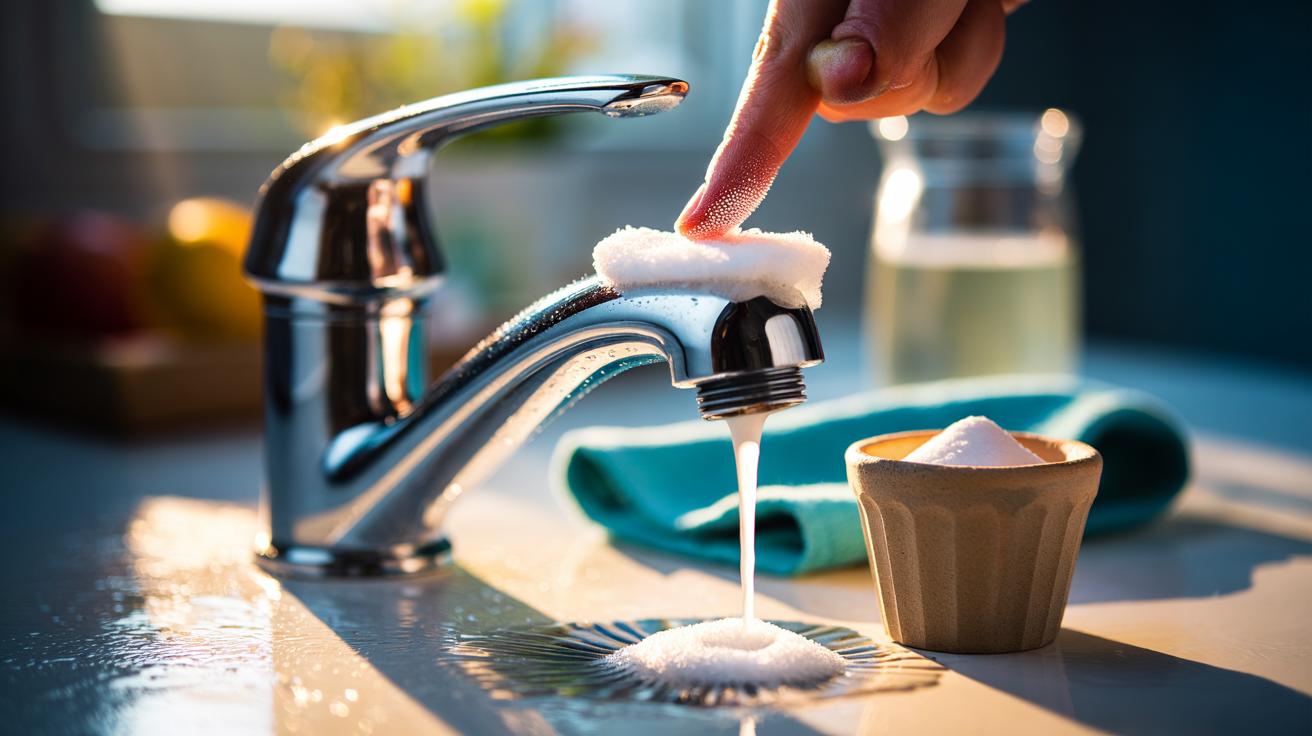
Apply the paste with a finger or soft brush. Work in small sections. Use light, circular strokes; pressure is the enemy of shine. Expect the grey film to lift almost immediately where the deposit is thin. For stubborn crusts, reapply and give it 60–90 seconds of contact time. Rinse thoroughly with warm water, then buff dry with a clean microfibre. Drying is non-negotiable if you want that mirror finish to last.
For the aerator, unscrew the tip, dab on paste, and scrub the screen gently. Rinse, reassemble, and run the tap for 10 seconds to clear any residue. To slow future build-up, wipe a drop of washing-up liquid over the tap, then buff — it leaves a faint hydrophobic film that repels spots without any waxy feel.
Hard Water Realities: Matching Method to Mineral Content
Not all water is equal. Knowing your local hardness helps you pick the right contact time and whether to add an acid step. In the UK, regions vary dramatically, even town to town. Adjust the sequence, not your standards. Use the quick guide below:
| Hardness (mg/L as CaCO3) | Classification | Recommended Approach |
|---|---|---|
| 0–100 | Soft | Bicarbonate paste alone; brief scrub and rinse. |
| 100–200 | Moderately hard | Short vinegar/citric pre-soak, then bicarbonate polish. |
| 200–350+ | Hard to very hard | 10-minute acid wrap, thorough rinse, bicarbonate scrub, buff dry. |
The table keeps things simple, but technique still matters. In very hard areas, focus on edges and seams where mineral salts accumulate, and be consistent: a 30-second wipe after evening use beats a monthly battle. If your kettle furs up weekly, your taps are likely scaling daily even if you can’t see it yet. Frequency and finesse trump force and frustration.
Finish-Safe Cleaning: What to Avoid and When to Switch
Most chrome and stainless finishes tolerate bicarbonate well, but care counts. Avoid stiff brushes, melamine erasers, or gritty powders that can introduce micro-scratches, especially on modern PVD and matte black taps. Test an inconspicuous spot first. If you feel drag or see dulling, stop immediately. For lacquered brass or living finishes, stick to a damp microfibre and a dab of mild washing-up liquid; use bicarbonate only on internal parts like aerators.
Skip the mix-in-the-bowl “volcano” trick; fizz looks fun but wastes potency. Sequence instead: acid to loosen, bicarbonate paste to polish and neutralise, clean rinse, dry buff. Keep granules away from natural stone splashbacks (they can etch) and avoid leaving paste to crust on seals. If limescale returns fast, consider upstream tweaks: a tap-mounted filter, descaler cartridge, or simply installing a softer aerator that’s easier to clean. Smart prevention saves more shine than any single scrub.
Bicarbonate won’t turn hard water soft, but it will restore sparkle without the price or pungency of harsh chemicals. In minutes, you can cut through chalky rings, revive tired chrome, and keep fixtures gleaming with a routine that’s kinder to your lungs, your budget, and your finishes. Light pressure, short contact times, and a final dry buff are the golden rules. Ready to swap elbow grease for elegant technique — and will you test the acid-then-bicarbonate sequence on your most troublesome tap to see how quickly it transforms?
Did you like it?4.6/5 (25)