In a nutshell
- 🌿 Mechanism: acetic acid disrupts the cuticle, denatures proteins, and drives rapid leaf desiccation; it’s a contact herbicide, not systemic, so roots often survive.
- ⚡ Speed vs selectivity: delivers visible top‑kill in minutes on sunny, dry days but is non‑selective; best for small seedlings in cracks, weaker against deep‑rooted perennials without repeats.
- 🧪 Application: use household vinegar 5–6% with a drop of washing‑up liquid as a surfactant; avoid salt to prevent soil salinity; spray dry leaves with thorough coverage and no rain forecast.
- 🛡️ Safety: wear PPE (gloves, goggles); for 20–30% acetic acid add a face shield and avoid vapour; never mix with bleach or alkalis; label and store securely.
- 🇬🇧 UK guidance: prefer products with a MAPP number for labelled use; household vinegar isn’t a registered plant protection product; success hinges on technique and timing (sun, dry foliage, small targets).
Armed with a spray bottle and a pantry staple, gardeners across Britain are discovering a swift, stingingly effective tactic against paving‑crack intruders and seedling upstarts. Ordinary vinegar contains acetic acid, a potent contact herbicide that can desiccate tender foliage before the kettle has boiled. Results can appear startlingly fast. Leaves wilt, gloss turns to matte, cells collapse. Used thoughtfully, it’s a sharp, short-lived strike rather than a lingering chemical footprint. That distinction matters in small urban plots and wildlife‑friendly borders. Yet speed brings trade‑offs: non‑selective scorch, limited root kill, and safety rules worth respecting. Here’s how this kitchen chemistry works, where it shines, and when to reach for a different tool.
How Acetic Acid Burns Through Weeds
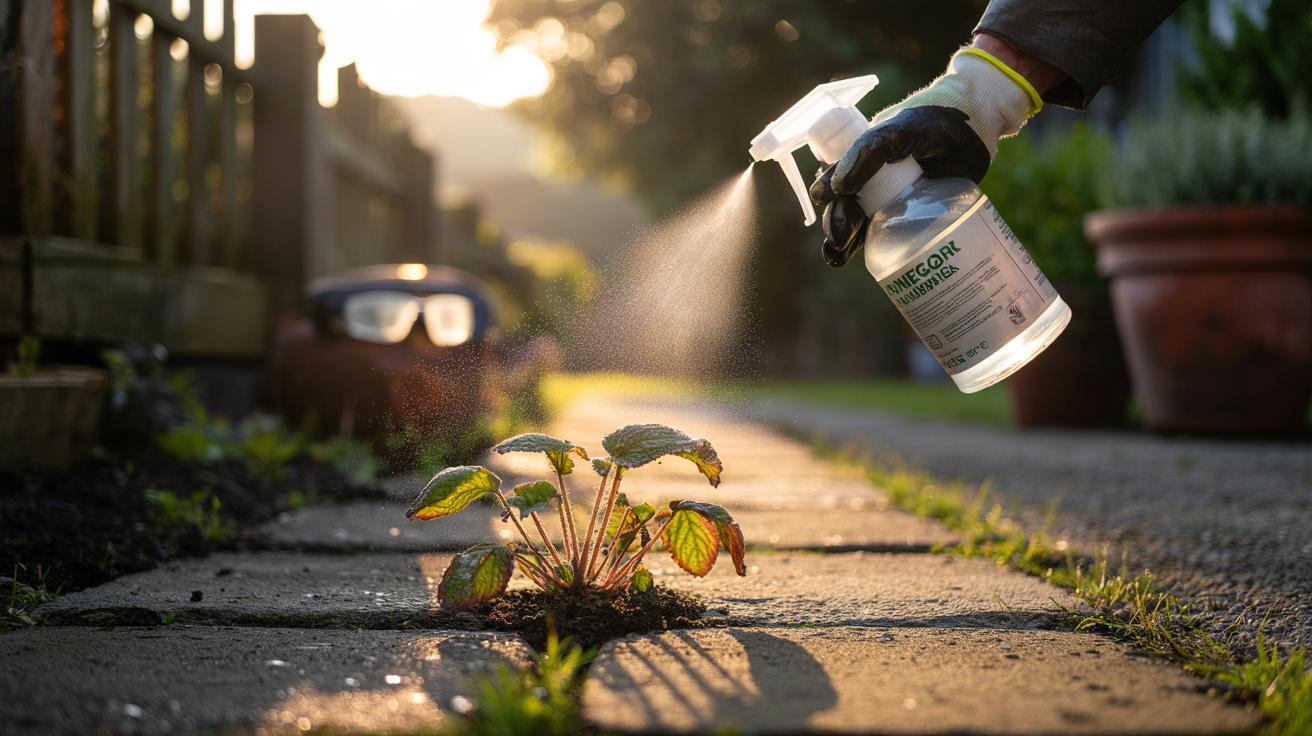
Vinegar’s bite rests on acetic acid, which disrupts plant tissues on contact. The acid softens the waxy cuticle, then penetrates epidermal cells, acidifying the cytoplasm and denaturing proteins. Water rushes out. Membranes rupture. The effect is visible as rapid desiccation — leaves slacken, edges bronze, and photosynthesis switches off. On a bright, dry day you may see tender seedlings collapse within 10–30 minutes; tougher leaves pucker and brown by late afternoon. The action is topical, not systemic, meaning the spray does not travel through vascular tissue to roots.
Strength and sunlight dictate the drama. Household vinegar (5–6% acetic) reliably top‑kills small, soft annuals; 8–10% solutions quicken the scorch; horticultural vinegar (20–30%) is ferocious but hazardous. Heat and low humidity amplify the burn, while shade and thick cuticles slow it. Because it’s a contact herbicide, coverage is everything: missed leaflets keep pumping carbohydrates to the crown. Younger weeds are far easier targets than established perennials with insulated buds and stout taproots.
There’s chemistry in the aftermath too. Once diluted in soil moisture, acetic acid neutralises to acetate and water. That’s why gardeners value the lack of long residual activity. It also explains the need for precision: the punchy bit happens at the leaf surface, in minutes, not weeks. If roots survive, regrowth follows.
Speed Versus Selectivity: What Vinegar Can and Cannot Do
Call it ruthless and short‑sighted. Vinegar torches green tissue fast, yet it rarely delivers a permanent cure on deep‑rooted weeds. Dandelions, docks, and plantains may look defeated by dusk, only to rebound from stored energy in days. It is also non‑selective: drift onto lawn grass, herbaceous perennials, or the edge of a prized courgette leaf, and you’ll etch a brown signature you didn’t intend. Always protect nearby ornamentals; vinegar does not discriminate. The win comes on patios, gravel drives, and vegetable paths, where seedlings and shallow annuals dominate and regrowth is simple to re‑treat.
| Vinegar Strength | Best Targets | Typical Result Time | Repeat Needed? | Safety Notes |
|---|---|---|---|---|
| 5–6% | Seedlings, soft annuals | 10–60 minutes (sunny) | Often, within 1–2 weeks | Low irritant; avoid eyes |
| 8–10% | Young weeds, thin leaves | 5–30 minutes | Likely for perennials | Gloves and goggles advised |
| 20–30% | Tough foliage, moss/algae | Minutes | Probable on deep roots | Caustic; serious PPE required |
So where does vinegar shine? In cracks between pavers, along edging stones, across gravel or hardcore, and in newly cleared beds before sowing. Where does it stumble? Dense swards, woody stems, waxy leaves, and anything rebounding from perennial roots. For those, repeated spot treatments, mulching, or mechanical removal prove more durable, and safer for surrounding plants.
Mixes, Methods, and Safety for Home Use
The simplest approach is often best: plain household vinegar in a clean trigger sprayer, applied to dry leaves during bright midday sun. A drop or two of washing‑up liquid can help as a surfactant, improving wetting on glossy cuticles. Skip salt. It marginally boosts burn but risks long‑term soil salinity and collateral plant stress. Aim for thorough, leaf‑by‑leaf coverage on small weeds; shield favoured plants with cardboard. Don’t spray before rain. Water dilutes the acid and splashes droplets where you don’t want them.
Safety deserves equal billing. Wear gloves, eye protection, and long sleeves; for 20–30% acetic acid, add a face shield and avoid inhaling vapour. Never mix acids with bleach or alkaline cleaners — toxic gas can form. Label any decanted bottle clearly. Store away from children and pets. Treat hard surfaces first to learn the pattern of drift, then move into tighter spaces. In edible gardens, keep off crops; if you mis‑spray, rinse leaves at once with water, then reconsider your wind conditions and nozzle setting.
In the UK, choose products carrying a MAPP number if you prefer a labelled acetic‑acid weedkiller and the guidance that comes with it. Household vinegar is a food product, not a plant protection product; using it as a herbicide sits outside typical label directions. Check local advice, and stay sensible with storage and disposal. The winning formula is technique plus timing: abundant sun, dry foliage, small targets, and the patience to repeat where roots persist.
Vinegar earns its “wonder” tag through speed, simplicity, and the lack of lingering residues, yet it rewards the pragmatic gardener rather than the romantic. Think of it as a scalpel, not a sledgehammer: excellent for tidying paths and suppressing waves of seedlings, less so for entrenched perennials that laugh at a single spray. Paired with mulches, sharp hoes, and spot re‑treatments, it becomes a tidy, low‑tech system. The trick is knowing when to stop and when to switch tactics. In your patch, where would a quick, targeted burst of acetic acid make the biggest difference this weekend?
Did you like it?4.4/5 (27)